
On November 17, the Public Service Commission of West Virginia granted Monongahela Power and Potomac Edison a certificate to build a 1,200-megawatt combined-cycle natural gas plant at the Fort Martin site in Monongalia County. The commission also authorized three solar projects with a combined 70 megawatts at Valley Point, Davis and Wylie Ridge. The estimates are $2.48 billion for the gas plant and $182 million for the solar projects. These are approved projects and disclosed cost estimates. Construction, final costs and delivery to customers will take longer to establish. Commission order · Commission announcement
The decision puts two calendars in view. The developers want to buy equipment and build a plant that can later supply electricity. Existing customers may begin paying financing costs years before the gas plant produces power. The commission authorized a Generation Projects Surcharge framework. The companies estimate the initial residential effect at about $1.18 per month, or 0.9 percent, with amounts to be established through a subsequent filing. Approval of a mechanism tells people how a bill can change. It does not fix the amount on each household’s bill. Commission notice on the surcharge · WV News on the remaining filings
The need for additional generation and the size of a potential data centre load were both before the commission. The proceeding records a possible large load that rises from 100 megawatts in 2028 to roughly 1,012 megawatts by 2033. Those are projections, with uncertainty about whether the load will arrive. The commission found a case for additional supply even without it. Customers can read those two findings together. The public decision authorizes the plant. Any power contract for future data centres still has to allocate the costs and risks of the particular service. Commission order · WV News on the projected demand
Gas and solar have separate construction schedules#
The certificate covers development of the planned Maidsville Energy Center at the existing Fort Martin Power Station and solar capacity at three separate locations. A combined-cycle plant obtains power from gas turbines and from steam generated using heat from the first stage. It still needs gas supply, cooling and a route to put electricity on the network. The solar projects have their own land, connection, equipment and operating conditions. Adding the nameplate figures describes the authorized portfolio. It does not show how much energy it will provide every hour. Commission announcement on the approved capacity
Times differ across the portfolio. WBOY reported that the original plan targeted late 2031 for the gas plant. FirstEnergy’s quarterly filing says it signed a reservation agreement with Siemens Energy for turbines scheduled for delivery in 2030. That milestone addresses availability of major equipment. Site construction, grid and fuel connections, installation and commissioning can occur on separate tracks. The same filing said the company expected to finalize the remaining major contracts after a satisfactory order. Nor does approving the certificate make the current coal station’s operations, the gas plant’s operation and the solar projects a single schedule. FirstEnergy quarterly filing · WBOY coverage
The capacity number is a measure of power. Energy is measured over time. A 1,200-megawatt nameplate does not establish continuous output, the figure accredited for reliability planning or how much firm service can be delivered to a particular distant customer. Temperature, testing, maintenance, fuel supply and network constraints can change what is available. Solar output depends on time and weather. A planner asks how the portfolio will contribute during periods of system need. A local bill may depend on the costs of that portfolio across the rest of the year as well.
A gas generator also creates a fuel planning obligation. The station needs to obtain gas when it will be called on, including periods when other users need it. An electricity supplier may value a contract that secures fuel transport over a delivery agreement based mainly on short-term availability. Such choices have a cost independent of the turbine price. If a customer expects the plant to provide reliable service, the arrangements for fuel and the electrical connection are as much a part of that service as the machine. An update on equipment delivery cannot settle those separate questions.
There is a separate construction timeline even after the turbines are reserved. The developer has to decide when to commit to supporting equipment and work, how to sequence a fuel connection with testing and how to check readiness at the destination of the power. A delay in one part can affect later acceptance while other expenses continue. The commission directed the companies to submit annual progress and cost updates beginning in January 2027 and give notice at least 30 days before construction. Reporting gives the public a basis for following changes in cost and commissioning dates as they occur. Commission directions on reporting
Each estimate also has a scope. The gas estimate concerns the combined-cycle facility and the solar estimate covers three other sites. Their sum is about $2.662 billion before any later changes to the reported estimates. That arithmetic does not say what utility customers are paying at a given time. Financing costs depend on timing and recorded spending, while operating costs and market purchases depend on dispatch. An explanation of rates has to distinguish the construction estimate from the annual amount the regulator permits the utilities to collect.
The forecast has an important threshold of its own#
In the case record, the possible large customer was discussed as growing to around 1,012 megawatts in 2033. Comparing the figure with a 1,200-megawatt plant shows why the forecast attracted attention. The figures refer to a projected customer requirement and a facility’s capacity, respectively. Dividing them yields roughly 84 percent, without measuring any share of energy that the plant will provide to the customer or any cost it will pay. Determining that would require a connection study, a service agreement and data on real demand. Order and testimony discussed in the proceeding · WV News account of the forecast
A data centre often grows in steps. A customer can occupy a first building and make later expansions conditional on equipment, demand or power. In planning, a possible 100-megawatt early load can raise a different procurement issue from a later requirement ten times larger. The first forecast date also precedes the planned late-2031 operation of the gas plant. Meeting a near-term load would require a plan for available generation, purchases or other service. The order does not identify a completed bridge-power project for the prospective customer. Commission order · FirstEnergy description of planning
The size of the demand also has a time component. A 100-megawatt load running at that level for all 8,760 hours of a normal year would take about 876 gigawatt-hours. That is a conversion, with no assumption of continuous operation for the company in the proceeding. A customer can have a peak load and use significantly less energy over the year. The utility needs to plan how it will serve a peak while also knowing how many units it could expect to sell. The monthly or annual charge can reflect those separate obligations in different ways.
There is a case for acting before every customer has committed, and a risk in doing it. A utility can need several years before a power plant is available. Waiting for the final customer signature may delay capacity it has to provide to people already connected. Building against a forecast can leave people paying for a larger plant if demand grows more slowly. The right comparison starts with a baseline of existing customers, forecast demand, retirements and access to purchases. The larger customer scenario then shows what changes when the new load is added.
According to WV News’s account of the order, the commission concluded that more generation was needed even without the prospective data centre demand. It cited projected shortages, wholesale prices and reliance on the regional PJM market. The utilities had projected a need beginning in 2029 and continuing through 2045. Dates like those are estimates from resource planning, not a schedule of inevitable outages. They help explain why the commission approved capacity while leaving contract terms for a large future customer to be negotiated. Commission announcement · WV News on the commission’s reasoning
A resource plan addresses supply under more than one condition. Buying power in the region can reduce the need to put capital into a particular plant. It can expose the utility to future prices, delivery constraints and availability at a particular hour. Owning generation has planned operating costs and can give a utility another place to source power. It also carries construction, fuel and maintenance risk. Results depend on the assumptions used for several years, including seasons when different parts of the fleet are out of service. That is why a public need finding matters at the same time as review of how costs are distributed.
For example, the planned plant date falls after the first year of the utilities’ projected shortfall. Even with the certificate, resource planners must consider how they will meet reliability obligations in the intervening years. A capacity purchase could address part of a planning need without supplying every unit of energy later used. Maintaining a generator or postponing a retirement would have different cost and performance implications. These are examples of what to compare. They explain why authorizing a plant several years out leaves room for changes in near-term supply as actual demand becomes known.
What the construction surcharge pays for#
The Commission’s announcement describes a surcharge for financing costs during building and a period after the resources begin operating, until the costs move into base rates. The order calls for recalculation on a semiannual basis using actual construction work in progress. The first charge is planned for March 1, 2027 subject to the separate rate process. The exact collection depends on spending, the applied financing formula and the customer allocation ultimately reviewed. That can make the charge change during a multi-year project. Commission order, conclusions and ordering paragraphs · Commission explanation
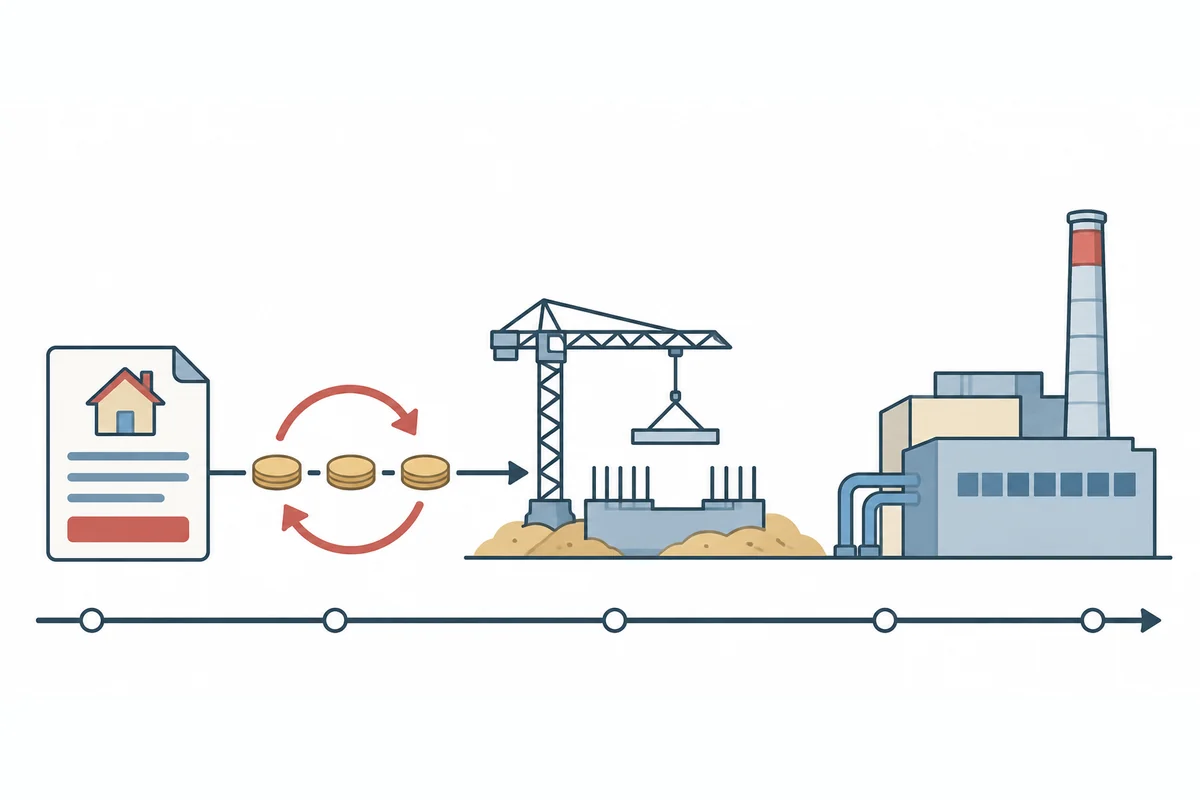
In a simple example, a customer might see a construction charge before the new generator contributes power. The rate is intended to pay for financing the eligible investment as work proceeds. Later, once equipment is in service, a base rate review can take account of the asset and the costs approved for ordinary rates. The same investment should have a clear transition so that readers can track which financing amounts were collected under the surcharge and which amounts are reflected in base rates. The two figures should not be added as if they were the same kind of charge.
FirstEnergy described the proposal as cash recovery associated with construction work in progress rather than waiting for all financing expenses to enter future rates. There is a tradeoff. Collecting during construction can ease pressure on the utility to finance costs until the project is in service. It makes present customers contribute before receiving the potential benefit of the new equipment. A later review that looks at actual recorded work can adjust the amounts as expenses and schedules change. That review is also a chance to examine whether the forecast that supported the investment is still on track. FirstEnergy quarterly filing · Commission order
Semiannual calculation gives the parties a common time to ask what changed. A period could show new costs for equipment already manufactured or commitments moving to a later year. These facts can affect the balance used in the calculation. A filing can also state the deadline for customers to participate and the period during which the resulting tariff will apply. A reader comparing successive bills can then connect a change to the relevant balance and docket, even if the project’s final cost remains uncertain. A construction estimate that stays flat can coexist with a changing finance charge.
The $1.18 residential example came from the utilities. It is useful as an indication of their proposed initial scale. A household should look at the applicable tariff, consumption and any other changes to the bill. The proceeding also has to determine allocation among classes. A particular group’s share may depend on use of the system and the method chosen. It is possible for a small residential estimate to be accompanied by a different effect for a commercial or industrial customer. The subsequent filing will distinguish the estimate from enforceable rates. Commission announcement · WV News on class allocation
There is more than one charge on a utility bill. A generation project can have a construction financing line, and fuel or purchases can be considered under other mechanisms. FirstEnergy describes an existing process for net energy costs including fuel and purchased power. As the plant advances, readers can distinguish service expenditures, the financing rate used during building and later charges associated with operating the facilities. A number that includes one of those items may be reasonable on its own while offering little information about a household’s total outlay. FirstEnergy discussion of West Virginia ratemaking
Large-load protection lives in the terms that are still being negotiated#
The order directs the companies to negotiate terms for large new customers with payments and financial protections for existing customers. The commission did not prescribe every provision. In the quarterly filing FirstEnergy said any contemplated data centre agreements using Maidsville output would be expected to address pricing, risk transfer, customer protection and long-term benefits for existing customers. Those statements provide a direction, with no disclosed executed service agreement in this order. The next evidence is what the utilities, the customer and the regulator do with those terms. Commission order · FirstEnergy filing · WV News coverage
An agreement can protect against different risks at different times. A deposit or bank guarantee may matter while infrastructure is planned. A minimum payment for reserved service can matter if actual demand arrives later or spreads to other locations. A term for early termination can decide whether a cost stays with the departing customer. A regulator can also review whether projected usage is realistic and what equipment serves more than one customer. These are examples of how an arrangement can allocate an expense. They are not a checklist of terms that the commission has already approved in this case.
The dates of a guarantee matter as much as the amount. A large customer can reserve a service years before it begins drawing the full load. If protection begins only when the customer is operating, expenses that were paid earlier may fall outside it. A utility and a customer can instead define which preparatory work is covered at each stage and how release or replacement of security is handled. Another buyer might pay for an equipment order up front. The commission’s instruction to negotiate leaves those design questions open. They will matter to any existing customer asked to contribute during the same period.
The share of the cost attributable to a new customer is an engineering as well as an accounting question. Some equipment might be designed to serve broad demand and still run efficiently for new customers. A particular substation or line could be needed only to connect one large project. Generation could be justified at one size by the baseline and another by growth. The agreement can document how the parties determined the incremental costs. The decision on who pays is clearer when it follows the equipment and services that the load actually requires.
An arrangement can also answer what happens if the new demand is smaller. A customer might take one building and defer the second. The utility can ask which substation work it would still need and whether generation could be redeployed to serve other users or sold regionally. A contract can distinguish investment that is useful elsewhere from investment built for a specific location. The answer affects whether an upfront payment or an ongoing rate is appropriate. It also gives regulators a way to judge a change in the customer’s plan without assuming the costs or benefits will automatically move to everyone else.
WV News reported that Energy Efficient West Virginia argued the approved protections do not yet assure that future data centre customers pay the costs of infrastructure built for them. The paper also reported that the commission received 986 opposing comments and 60 supporting comments. Those are submissions in one case, not a survey of the state. The concern is concrete. If the expected campus does not expand, who pays for the unused share of what was built? The order calls for negotiation of protections. Their practical adequacy will be shown by contract provisions and later billing decisions. WV News on the response and case comments
The potential for cancellation also remains relevant. WV News reported that the commission declined to give advance recovery for abandonment costs, leaving those questions to a possible later proceeding. A project that is cancelled, one that is delivered late and one that is delivered below its estimated cost create different issues. A commission can examine whether expenses were prudently incurred and which party agreed to pay them. Reading the approval as an unconditional guarantee of every cost would miss the later scrutiny that the case preserves. WV News on abandonment recovery
The public can follow the project through three records#
Progress will appear first in regulatory filings on the surcharge. Those should show the actual eligible construction balances, how the requested amount was calculated and the proposed distribution across customer classes. People can compare updates to see whether spending moved earlier or later than expected. Board-level estimates and rate authorizations may instead be based on different methods and periods. The name of a filing and the dates it covers matter when comparing changes. Commission order
The utility’s public notice can help readers make that comparison. The regulatory decision describes the scope of a charge, while a tariff filing puts forward rates for identifiable groups of customers. A notice can point to the date and method for submitting comments. A documented review can explain how the commission considered the filing and the response. People can then ask a concrete question about the electricity they buy, such as which cost changed and when the new charge begins. That discussion becomes harder if a first estimate is repeated as already approved or a construction certificate is treated as a bill.
Construction has a separate record. Turbine delivery, completion of gas and electrical work and successful tests do more to establish operation than the spending line alone. It is particularly useful to see which resources have entered service. Three solar sites and a combined-cycle plant can start at different dates. When one begins operating, customer billing and financing for another can remain in the construction stage. Annual progress reports can make this difference visible. Commission reporting directions · FirstEnergy on equipment reservation
The third record will show whether the prospective load becomes a customer with obligations. The phases actually requested, the terms for a delay and any investment that would be needed even without the customer should remain distinguishable. The company can report an authorized customer agreement without sharing proprietary usage details. The commission can make the cost protections and oversight clear enough for existing customers to evaluate. Those steps will explain whether the planning forecast led to a service contract with a defendable division of expenses or a later revision of the plan.
Fort Martin now has a state construction certificate and a mechanism for recovering approved financing costs. The development team still has to build the plant, line up supply and commission the equipment. The utilities and their regulators still have to show how bills are determined and how speculative or later demand is treated. The $2.48 billion estimate and 1,200-megawatt figure tell the scale of the decision. The rate filings, delivery reports and large-load agreements will tell customers how that decision reaches their bills.