
Aurionpro Solutions told the Indian exchanges on November 19 that an unnamed hyperscaler had awarded it additional work on an AI-ready data centre in southern India. The filing puts the additional order at approximately ₹100 crore, or ₹1 billion, before applicable goods and services tax and reimbursable costs. It specifies nine months for execution and describes a package that spans design, detailed engineering and delivery of mechanical, electrical and plumbing works. The customer is described as an Indian entity, while the customer name is withheld for confidentiality. In a companion announcement, the company put the cumulative value of its engagements with that customer above ₹400 crore. Exchange filing · Company statement
A follow-on award is useful evidence that the buyer is committing more work within a known relationship. The engineering significance lies in how much of the supporting plant the contractor can take from drawings to verified operation within that package. The public filing leaves the site address, utility allocation, rack density, design load and acceptance schedule unspecified. It also leaves open the relationship between the nine-month work period and any date when the operator would make capacity available to a customer. Those missing details matter because the same description, AI-ready, can cover several stages of a project that carry very different delivery risks.
The order has its own accounting boundary#
The November number describes a defined addition to a commercial relationship. A crore is ten million rupees, so the approximate order value is a billion rupees, and the reported cumulative engagement is more than four billion. The exchange filing expressly excludes applicable GST and recoverable items such as reimbursements from the amount assigned to the additional order. A company that purchases equipment on behalf of a customer, for example, may treat some expenses differently from its own engineering or installation work. Anyone comparing orders needs to know whether those amounts are included on both sides. The same currency and the same label for an order are a starting point for a comparison.
Aurionpro announced a mandate worth close to ₹350 crore in March for the design, engineering and delivery of its first AI-ready data centre with a leading hyperscale operator. November’s companion announcement describes the new work as an expansion of the engagement announced earlier in the year. The company’s October results also give a separate geographic reference, a Navi Mumbai project with cumulative orders close to ₹300 crore. The public documents give enough information to distinguish the place names and the scope of each disclosure. They leave the identities of the confidential buyers and the relationship between all of the commercial totals open. Treating each release as a standalone line item avoids double-counting a customer relationship that has been described with different boundaries. March order announcement · October results
The same discipline helps when reading quarterly accounts. A signed order can authorize procurement, design work, site installation, staged acceptance and later settlement on different dates. The exact billing and revenue recognition depend on the contract and accounting policy. An upstream supplier’s lead time can move cash out before a progress payment arrives. A contractor can finish a portion of work while awaiting a customer’s sign-off on an adjoining system. November’s announcement records an award and an execution period. Progress bills, receivables, acceptance notices and reported revenue over subsequent quarters would show how much of the order has converted into performance and cash.
There is a useful clue in the fact that the order adds to an existing engagement. Where two teams already share a set of drawings and an understanding of how changes are approved, a repeat award can preserve time and accountability. A revised requirement can also send work back through design review or require a manufacturer to change a deliverable. The disclosure gives no allocation between retained scope and newly specified work. The sensible reading is that a returning customer has chosen the contractor again, while the commercial meaning of that choice depends on how well the teams close technical interfaces during execution.
Why the supporting plant governs usable capacity#
Mechanical, electrical and plumbing contracts put physical systems around computing equipment. In a typical high-density hall, an electrical path carries energy from a utility or other supply through transformers and distribution to the racks. A mechanical path carries heat from those racks to equipment that rejects it outdoors. Supporting controls coordinate equipment as loads and outdoor conditions change. Plumbing connects equipment that relies on water or another fluid and helps make maintenance and fault isolation practical. A facility can have an impressive total equipment rating on a drawing and still use only part of that capacity if either path lacks an essential component.
Consider a hypothetical hall with equipment delivered at the scheduled time. Distribution hardware might be sized for the final design load, while only the first utility connection has been accepted. Conversely, the feeder might be available while the heat rejection equipment awaits installation or commissioning. The actual capacity available to the operator would follow the binding constraint at that moment. Adding the nameplates of electrical or cooling equipment would describe the equipment ordered. Deliverable IT load requires a scope, a time and evidence that every part of the path can carry it. The filing gives no megawatt figure, so no conversion from rupees to rack load is justified.
At the building boundary, a capacity statement needs to identify the meter or point in the distribution system to which it refers. IT equipment power is measured on a different boundary from all power entering a facility. Cooling compressors, pumps, fans, controls, lighting and losses also use electricity. The same ambiguity arises when a site is described by its connection capacity, which may be firm, conditional or contracted in phases. A purchaser looking for capacity to run workloads needs the accepted IT capacity and any operating conditions attached to it. A utility planner needs the demand the facility can place on the grid and the timing of that demand.
One way to make the distinction concrete is with a synthetic month. Suppose facility meters recorded 10.4 gigawatt-hours over that month and IT meters recorded 8 gigawatt-hours over the same interval. The ratio would be 1.30 for that measurement period. It would answer a question about energy over time at the selected boundaries. The utility still needs the greatest load the site could draw at a particular time, including concurrent cooling equipment and the way plant responds to faults. A monthly ratio cannot supply the missing instantaneous load. The example uses no Aurionpro measurements. The underlying distinction follows the US Department of Energy’s guide to metering facility and IT energy. Data centre energy design guide
Design choices travel with the workload#
An engineer working on an AI-oriented hall needs an explicit workload and equipment assumption. The design depends on the heat density anticipated at each rack, the proportion of liquid and air cooling, the acceptable coolant or air conditions and the number of racks commissioned together. Moving from a uniform rack layout to a small set of dense clusters changes how power and cooling have to reach the room. If hardware selection changes after drawings are issued, the consequences may show up in cable routing, pipe clearances, residual air cooling or maintenance access. This is why the specific design schedule matters even when a building’s overall use was agreed early.
Liquid cooling illustrates the distinction between a capability and an installed system. A facility can include floors and risers that leave room for distribution and specify a future connection point, while current racks use air. A later phase might connect coolant distribution units that transfer heat from a rack loop to a facility loop. That later phase will need accepted temperatures, pressures, flow and chemistry at the boundary, as well as a way to isolate equipment for maintenance. A design can also use both kinds of cooling in the same room. The November filing provides no rack cooling specification, leaving this as an engineering question to ask when further design details appear.
The site also has to reject the collected heat somewhere. Local weather affects the hours during which different equipment can operate efficiently. Available and permitted water can affect the choice between cooling arrangements. Two layouts that draw the same IT power could therefore require different plant, control sequences and operating costs. Even a closed loop within a rack leaves a building-level heat rejection problem. The local climate data, operating temperatures and actual heat rejection equipment would support an assessment of energy and water use. The southern India description is a region without enough site data to infer those conditions. Cooling water and data centre design
Density affects commissioning as much as it affects design. An installation can be checked at a small load so the team can correct wiring, controls and leaks before introducing additional risk. Subsequent tests have to show that distribution and cooling keep meeting the design requirements as more racks are occupied. Test loads can represent a planned operating condition without using the eventual customer’s hardware. Engineers then need to state which assumptions the test exercised and which will be confirmed once equipment is installed. An operator using the hall later should be able to trace a capacity promise back to tolerances, tested conditions and any constraints on simultaneous use.
What nine months can tell a buyer#
A work period has meaning once the handovers at its boundaries are understood. For a package covering design and site work, the contractor depends on items such as an approved brief, equipment information and access to parts of the building. Other parties may control the shell, civil works, upstream utility installations and the customer’s installation schedule. A contractor can organize its own purchasing efficiently and still lose time when a prerequisite slips. The November filing gives the planned execution duration. It provides no public start milestone, no schedule for utility energization and no list of third-party conditions for the first usable room.
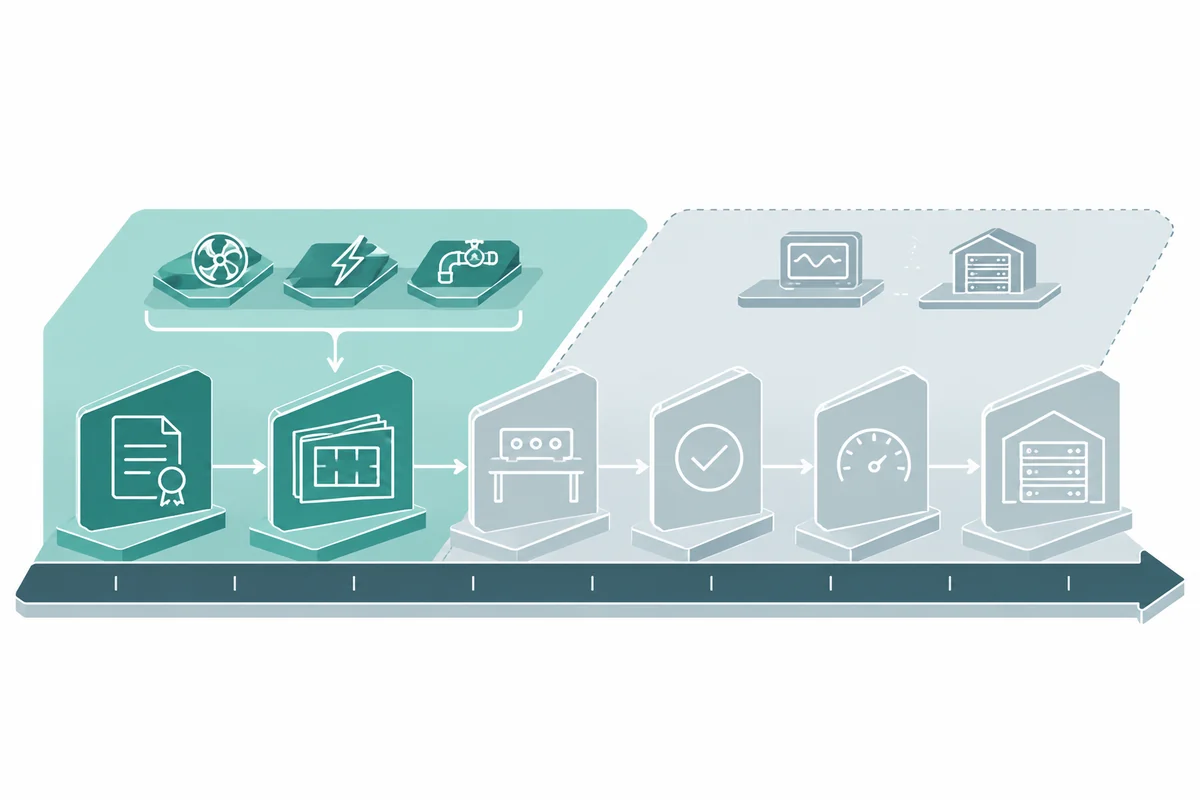
Long-lead items turn the interface schedule into a physical issue. An approved design can specify a transformer, a distribution board or a cooling unit well before the floor can accept it. The manufacturer needs dimensions and ratings fixed before fabrication. The site team needs to know the delivery sequence, the route into the room and how the installation will be tested and serviced. A late change in electrical rating can affect other equipment selected on earlier assumptions. Advance procurement can save time where requirements are stable. Where the customer’s requirements remain open, the team may gain more from a clarified interface than from placing more orders sooner.
Aurionpro’s October results describe a facility in Bhiwandi, near Mumbai, that supports project execution with warehousing, fabrication and assembly. The company’s disclosure gives context for how it wants to handle delivery bottlenecks. Repeating a proven assembly in a controlled environment can make inspections and documentation more predictable. The benefit for an individual site comes when the assembled equipment fits the approved arrangement, arrives at the needed time and meets the same inspection requirements as site-built equipment. The public announcement leaves the equipment and manufacturing routes for the November package unspecified. The Bhiwandi example helps readers ask how much execution is under the contractor’s control. October results and operations update
The buyer can track useful intermediate progress on several axes. Approval of coordinated drawings reduces the risk of a mismatch at installation. An accepted factory test shows that a specific item met defined conditions before shipment. Mechanical completion establishes that equipment has been installed to a known scope. Energization makes a supply available for checks. Integrated systems testing exercises how equipment and controls behave together. These dates can differ by hall, subsystem and load level. A single schedule in a press release becomes much more informative once the involved parties identify which of those dates the current package is expected to achieve.
The handover is a test of the whole installation#
Commissioning begins by checking the equipment against what was designed and ordered. A typical electrical inspection includes records of ratings, installation, settings and functional operation. A mechanical inspection examines flow, temperatures, alarms and access, alongside the condition of the equipment itself. The teams then have to confirm the response of the connected building. A pump that meets its own specification still depends on the system around it, including controls, protection and the other equipment left running during maintenance. At higher load, a fault affects more heat and power. This makes the behavior of the installed system under defined disturbances as important as individual findings.
An example is the way a room responds when one supporting component is taken out of service. A credible test states the load at the time, what was removed, which backup systems acted and what the instruments traced. It also records how quickly operations stabilized and which operating limits applied while the remaining equipment carried the load. Two independent rack feeds can contribute to resilience. The design and the test still need to account for any equipment or control path shared by the feeds. A single availability label in a sales presentation gives less information than a completed test record tied to a specified boundary and a specific room.
A contractor delivering a system should leave the operator with materials that make it maintainable. Configuration records, verified drawings, spare parts, procedures and training can shorten the time required to deal with an ordinary fault. This matters especially when work in one room will continue after another room has entered service. Controls and electrical separation can make that phasing manageable if the operating team knows which assumptions went into the design. A successful handover involves confirming that the facility can be operated under the planned staffing and maintenance arrangements. The award disclosure contains no information about training or long-term operations, so their responsibility and scope await clarification.
Some of the most consequential boundaries are outside the contractor's package. Grid energization is a decision and an action backed by connection requirements, inspections and agreements. A regional permitting approval may refer to one building or stage, with subsequent approvals needed for other work. A customer installation date depends on the arrival of the computing equipment and its acceptance. A delivery update that mentions which of these milestones belongs to the contractor, and which party is responsible for the others, gives a much more useful picture of execution. This is the evidence to ask for before making a claim about new computing supply in the region.
How this development could change the competitive picture#
Companies that can coordinate engineering and installation have a plausible advantage when buyers want more predictable delivery. By purchasing a larger package, a buyer can give one contractor responsibility for more interfaces. The buyer still holds meaningful decisions about what is specified, which dependencies it owns, and how it will accept the result. An award for a larger package can reward teams with experience of finishing tight work periods. It can also concentrate responsibility for delays that originate in another part of the build. The commercial benefit depends on clearly defined boundaries, staged evidence and a way of resolving changes while keeping a common schedule.
Repeat engagements can reveal whether a method travels to the next phase or site. An approach that works once may depend on a particular team, vendor or set of conditions. A company can make delivery more repeatable by deliberately preserving specifications, acceptance records and knowledge of substitutions. This kind of repetition is useful to a customer even when the next project uses different hardware. The relevant measure is the amount of accepted engineering work that the buyer can reuse while still meeting site-specific requirements. November’s follow-on order gives a concrete opportunity for that reuse to matter. Its eventual effect can be assessed only against milestones over time.
At an industry level, the order adds one observation about contractor demand. It suggests a hyperscaler is commissioning more work with an existing vendor in southern India. The amount and scope cannot settle broader questions about how much computing capacity the region will have, which facilities will run at high utilisation, or how their power is secured. A useful regional comparison would pair construction awards with dates and conditions for new electrical connections, permitted facilities, commissioned IT capacity, and occupancy or use. Bringing those measures together would show what has reached the market and what remains an order book entry.
There is a further reason to resist attaching a general capacity estimate to the price. The work can include engineering, electrical equipment, mechanical plant and construction services purchased under a particular contract. The resulting cost per unit can change when a supplier’s package includes more of the scope, when the region’s electrical requirements differ or when equipment needs redundancy. Even two orders on the same campus can cover distinct phases or categories of work. A buyer seeking benchmarking data needs comparable component and schedule boundaries, which are unavailable in this release. The reported amount tells an important story about the customer’s commitment to a contractor in its own right.
The next evidence is an accepted installation#
For this job, the indicators worth following are confirmation of the defined scope, the delivery dates for the plant, the conditions for energization, and the milestones by which the customer will accept completed work. If the parties disclose a facility or IT load, they should identify which boundary applies, which capacity is commissioned, and which amounts are still planned. A later update could also describe which cooling loop has been installed and how much of the room has been tested. For a partial handover, the acceptance record can show which backup systems have entered service and the load they have carried together. These details would make it possible to distinguish progress on the contractor’s package from progress on the overall facility, even without the customer’s name.
More than ₹400 crore in disclosed engagements is a meaningful statement about the scale of a relationship, and nine months establishes a period in which to look for milestones. The most persuasive result would be a later record showing that the contractor completed the intended systems, that they were accepted together under stated conditions and that the operator could put the room to work at the promised time. A phase can satisfy that standard for a limited portion of a campus while other phases continue. That is what would turn the financial news into an infrastructure result, and it is the comparison that matters when the next customer asks how much capacity can actually be delivered.