
ChronoScale and STN announced a partnership in Odessa, Texas, on November 18. A subsequent SEC filing says the contribution closing occurred that day and the joint venture took over a dedicated GPU services agreement from STN. The publicly confirmed order covers the first 65 megawatts of a campus described as up to 350 megawatts. The first order gives the project deadlines and tests. The wider site gives the partners a place to try to expand. Telling those two commitments apart is the starting point for assessing what Odessa can deliver. ChronoScale’s announcement · SEC closing disclosure · STN’s announcement
Start with the work needed to put one group of servers in use. The project has to be able to draw power. The building needs to carry away heat and connect every rack to the cluster. The supplier has to deliver the purchased equipment. The customer then has to accept the service, with conditions depending on what it ordered. Each step can be ready on a different date. Closing the joint venture gives responsibility for this sequence to a specific entity. It does not certify that every step is finished.
The first 65 megawatts matter because they combine an order with a disclosed power arrangement. The contribution agreement records the STN parties’ representation that an allocation of 65 megawatts under the project’s facility extension agreement is firm, subject to the provisions and schedules disclosed to the parties. A firm allocation defines the right to use power under those terms. Construction progress, energisation, commissioning and customer acceptance still need their own evidence. Contribution agreement, section 3.12
The first phase has four dates inside it#
The original 8-K says the GPU services will arrive in four tranches. It expected the first in calendar Q4 2026 and the remaining tranches in the first half of 2027, subject to possible extensions. STN describes phase one as scheduled for the first half of 2027. Those timings can coexist. A part of the ordered capacity can become ready before the rest. The distinction matters to a customer planning a workload that needs much of the cluster at once and to a landlord checking how fast the site is drawing power. Original 8-K, GPU Services Agreement · STN’s timetable
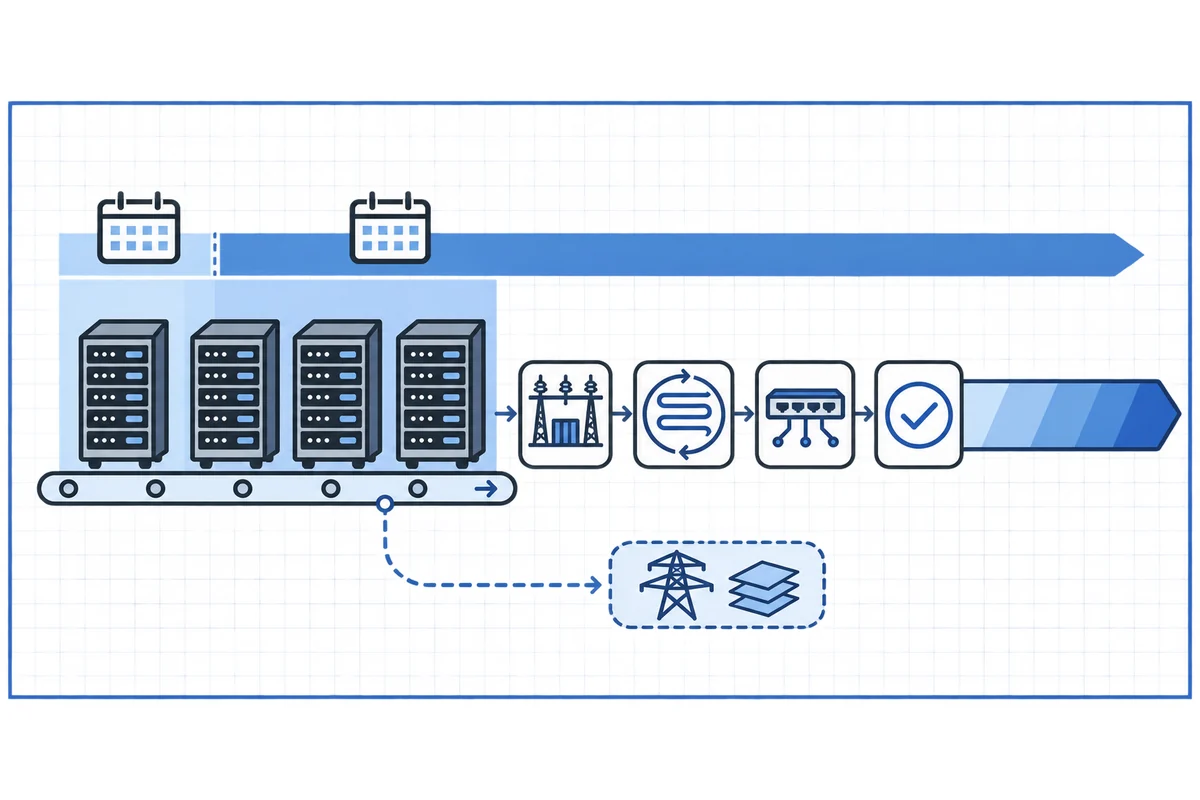
A computer cluster can be delivered piecemeal while still requiring systems across the site to work together. An initial batch can help operators check electrical loads, coolant temperatures and traffic patterns. The next modules may depend on the same substation, distribution system and optical network. An operator can complete all installation in a room and still have work to do before it has a reliable service. Initial results are valuable when they are clear about the equipment tested, the load in use and which part of the order they cover.
The 8-K describes acceptance tests and service-level commitments, along with delay discounts and termination rights under particular conditions. For a purchaser, these clauses put a definition around delivery. It might care about whether servers operate continuously under load, whether workloads see predictable network behaviour and how a failed component affects a whole cluster. Contract tests can use the agreed limits without disclosing the customer’s model or data. An installed rack and a rack that fulfills a tested service are at different stages. SEC filing on acceptance and service levels
Acceptance across several deliveries gives the owner a way to report the state of the service more clearly. It can list when equipment was brought into the building, when it was switched on and when the customer accepted it. The last of those can trigger a separate commercial event. A customer might be able to start smaller jobs on an early delivery while it waits for enough of the cluster to run a larger one. An operator might test a rack at its nominal electrical rating while the customer needs a sustained workload over an agreed period. Those distinctions can explain a gap between hardware and commercial dates.
The first-phase term is about six years for each tranche. The company says it could provide up to $7.5 billion of total contract value to the partnership over that period given full delivery and performance. It says a substantial portion of phase one is supported by the credit of an investment-grade technology company. The identities of the customer and that company were not disclosed in the cited filings. Credit support can make parts of the project more financeable. It does not do the work of connecting, testing and delivering the equipment. SEC filing on contract terms · ChronoScale’s announcement
A figure for contract value also needs a recipient and a period. The $7.5 billion refers to the partnership over the approximate term, not a sum deposited at signing or a current revenue figure for ChronoScale. Nor is it a straight-line forecast of net income. Different tranches start at different times. Equipment, facilities, funding, maintenance and services each have costs. How the owners are paid also depends on their agreements and the order of distributions. The visible progress is how much of the contracted capacity passes acceptance and starts the service term.
A power agreement establishes one boundary#
The November 17 contribution agreement names an Oncor transmission and substation facility extension agreement and a related retail supply agreement with Ammper. It says the 65-megawatt allocation is firm except for the conditions expressly set out in the agreement and the relevant schedule. The contract also requires further documents after closing, including third-party consent to assignments and confirmation of the required operating milestone. This is substantial information about availability and outstanding tasks. A site visit, utility confirmation and load data would answer other questions about what is actually running. Contribution agreement, sections 3.12 and 8.7
The terms refer to both the right to obtain capacity and the obligation to reach a required level of operation. Those concepts are related. A utility can construct and reserve equipment ahead of a customer’s full load. The customer may have to meet thresholds and dates under the deal, as well as the physical limit at its connection point. The public agreement describes obtaining an extension of the required-operation deadline to no earlier than August 31, 2027. That is a power contract condition to confirm. It does not replace the expected delivery dates of the customer’s first four tranches. Contribution agreement requirements
There is also a request for a load interconnection study for an additional 65 megawatts. The contribution agreement distinguishes that future development from the existing project and says completing the study is not a condition to the contribution closing. The engineering study can examine whether a further load can be served and what changes it might require. Submitting a request leaves its result open. Treating it as a second firm allocation would give the company a power right it has not disclosed. Contribution agreement, future development clause
Megawatts describe a rate of using or delivering energy. Power reserved at a substation and electricity measured over a year are separate things. If a site ran at a constant 65 megawatts for all 8,760 hours in a 365-day year, that would be about 569 gigawatt-hours. This is a unit conversion, not an estimate of Odessa consumption. Actual draw depends on how much is built and used, downtime, the operating configuration and where the load is measured. Cooling and electrical equipment also use part of the facility’s power. A statement about total available power leaves room to ask how much is available to the servers.
Even two numbers expressed in megawatts can cover different boundaries. Power at a substation, usable capacity inside an electrical room and sustained demand from the IT equipment are measured at different places. In a hypothetical facility where 65 megawatts were the total continuous input and IT accounted for five-sixths of it, about 54 megawatts would go to computing and network equipment. This arithmetic describes no specification for Odessa. It explains why a reader needs to locate the measurement point before using a power figure to estimate how many servers can operate. The utility allocation and the service order have distinct measurement and reporting purposes.
Reserve equipment introduces another boundary. A data centre may have backup power or storage sized for a particular kind and length of interruption. A kilowatt-hour stored for a short transient and a continuing supply arrangement cover different risks. STN describes the campus as incorporating on-site generation and battery storage. The statement does not give a measured share of ongoing electricity from each source. Buyers can check which services rely on the grid, what backup coverage the site delivers and how it makes the transition under load. STN’s description of the campus
The developer and the utility can also have different timelines for reporting loads. Equipment can be reserved before the buyer begins to draw on it regularly. Temporary commissioning loads can differ from normal use. A utility bill or public operating statement that covers a short test window would need a date and a boundary before it could be compared with the capacity in the announcement. The company’s eventual annual account could show multiple stages of growth as it adds tranches. That would help a reader understand the project’s effect on demand without treating every permitted megawatt as a continuously running load.
Modular construction reduces one kind of wait#
STN says the campus uses factory-built data centre modules. Data Center Dynamics reports that the company installed an initial module at Odessa in the summer of 2026 and described it as 2 megawatts with 1,024 NVIDIA B300 GPUs. Those are reported specifications for the earlier module. They help explain why a modular format is relevant to the joint venture. They do not establish how many such units the 65-megawatt order requires or how every later module will be configured. ChronoScale says GPU configurations vary by phase. STN announcement · Data Center Dynamics reporting · ChronoScale’s announcement
A factory can prepare similar assemblies in a repeatable environment while earthworks and electrical construction happen on site. That can reduce how much has to be built in sequence. It makes logistics a condition for using the earlier work. The site needs paths to receive the modules, a schedule for lifting and connection, test capacity and people who can resolve discrepancies. Standardising an enclosure can make these jobs easier to plan. Commissioning will still confirm which equipment was shipped, installed and attached to common infrastructure.
Earlier preparation does not remove decisions about the whole site. A modular build can leave room for a utility connection, future distribution circuits and the paths used to bring in equipment. These shared elements must satisfy the loads and maintenance plans for whatever phase is actually authorised. A team can make allowance for further construction without putting all the hardware for that expansion in service. The value of a modular approach can be measured in how much later construction can proceed while meetings, testing and operations continue with the first customer.
Cooling affects what the operator can run inside each unit and how a fault propagates. STN describes a sealed, closed-loop cooling system with no process-water discharge. That is a statement about a designed system and one kind of water flow. A complete water account would also examine how the site fills the loop, how heat is rejected, whether backup or other systems use water, and how accurately that use is measured. An engineering description is useful when it gives the specific boundary. Costs and operating data can show how the design behaves in service. STN’s cooling description
Hot weather can also make a thermal design behave differently from the conditions in a factory test. Customers may care about how much load they can use on a hot day, how system temperatures are monitored and who responds if cooling is interrupted. The supplier might have to certify that it can keep the equipment operating over the ambient conditions in its specification. Residents and local organisations will have different questions, including demand on local services across the year. A disclosure that states the test conditions and the equipment boundary may serve both groups more effectively than a single number for cooling.
Network and storage equipment create dependencies of their own. A job that was tested on a handful of servers may have different performance when it spans racks. When a switch or cooling component fails, the customer needs to know whether it loses one server, an entire rack or more capacity. Operators can plan and test failure domains, maintenance and service recovery before counting equipment as available. That work can influence the customer’s release of a tranche and the financing supported by it. It is also a reason to evaluate the modules as a connected service.
An early module offers a chance to collect operating evidence before scaling. The useful comparison uses the same tests on successive batches, identifying what changed in power density, hardware layout and cooling. If the first deployment exposes an issue, early acceptance criteria can prevent it from being repeated in later batches. A fast build becomes valuable through this feedback. The progress indicator is the rate of passing deliveries, with enough context to explain how the test changed when the equipment did.
The financing has separate cash and commitment lines#
The announced corporate package is up to $750 million. ChronoScale describes $250 million in equity arrangements and up to $500 million in a convertible preferred facility. The second 8-K amendment gives a more useful view on November 18. ChronoScale closed about $153 million of gross proceeds in the common stock placement, issued a convertible note to Applied Digital and sent the first $10 million preferred purchase notice. A notice and a ceiling on conditional future draws differ from proceeds already received. Financing announcement · Second SEC amendment
The venture itself has another capital structure. The parties have agreed to contribute $390 million in value each for their planned equal economic interest, subject to completion of the required antitrust review and note conversion. The closing amendment confirms the venture issued the $220 million convertible note to a ChronoScale subsidiary. The original 8-K describes $200 million of the note proceeds for the partnership’s purchase of GPUs from Super Micro and $20 million for general partnership purposes. Using specified funds for equipment gives clarity about one use while leaving total construction and operation to the rest of the funding package. Original 8-K · Closing amendment
STN’s contribution includes property interests, project assets and contracts valued at about $251.9 million in the agreement. Its remaining cash contribution is linked to obtaining qualified project financing covering at least 75 percent of the project budget under the disclosed terms. The stated $390 million per member includes more than cash handed over at the closing. A project can have a real drawing account for a purchase and still need to raise funding to cover what happens between supporting an order and operating it. Original 8-K, partnership terms · Joint venture agreement
The project company also entered a Macquarie term loan for about $74.7 million. The original filing says that loan helps repay some existing STN obligations and pays fees and expenses. It describes a 90-day term with 10 percent annual interest paid in kind. Those terms make refinancing and the timing of costs material. This is separate from the headline contract value. A large long-term sales figure can coexist with short-term work to replace bridge financing or fund equipment before its service date. The term loan description · The closing update
An equipment lender will also care about when the assets can earn revenue and which entity owns them if a deadline slips. A customer’s credit support can reduce part of the payment risk. The schedule and acceptance tests still matter to funding because equipment must be available, connected and running before a long contract can yield regular payments. A financing document may define a security interest in equipment and a service agreement may define when the customer accepts it. Different obligations can attach to the same rack. A delay in one can change the amount of working capital the project needs from another source.
This is why the order of spending matters. A project may pay its equipment supplier, install a batch and spend time in testing before the customer begins paying for the result. Staging the purchase lets the developer learn from the first tranche before some later outlays. It also leaves several milestones to watch at once. If equipment arrives before the electrical room is ready, capital can sit idle. If power arrives before the equipment, the developer may still have commitments for reserved capacity. The published agreements clarify who is trying to cover those mismatches.
The remaining 285 megawatts are a separate opportunity#
ChronoScale says it has a right of first offer over the remaining 285 megawatts of planned capacity. That right can give it an opportunity to negotiate for future phases. The company says the customer has no commitment to order phases two and three. A larger build will require more orders, terms and definitive agreements, along with land, permits, power, interconnection and financing. A planned campus can hold a place for those steps without completing them. The difference prevents a map and a set of rights from being read as a confirmed 350-megawatt order. ChronoScale’s disclosures on later phases
The company also supplies a figure of roughly $20.8 million in expected annual revenue per megawatt across the three contemplated phases, with differing GPU configurations. It is an assumption about a combined deployment with its own mix and conditions. Applying it to the first tranche as a guaranteed price, or multiplying it by 350 megawatts to forecast signed project revenue, would erase those conditions. The useful published numbers are the ordered scope and the terms that apply to it. Projections for later phases gain evidence when additional agreements are executed. ChronoScale’s blended estimate
The economics of the later capacity will depend on the new requirements. A larger cluster may need a different heat rejection system, more network links and support for equipment that did not exist when the original contract was signed. Infrastructure designed for a first batch can be a base for later work. Its usefulness is measured by how many of the site’s systems can be expanded without taking the first customer out of service or forcing costly changes. The 285 megawatts are a genuine opportunity to ask that question. Any answer depends on what gets ordered.
There is also a distinction between reserving the ability to negotiate and financing construction. The right can preserve a useful choice while the next customer order is uncertain. It does not require another company to accept the offer or pay for a connection. A developer can prepare a later phase in stages, for example by identifying what a utility study would need before committing to a building or a batch of servers. The commercial value of that preparation increases when the conditions and timetable are explicit. The proposed expansion can then be judged at the next decision point instead of treated as if it is already earning revenue.
For the market, the next milestones are specific. The filing can confirm project financing and additional power permissions. The developers can report which customer tranches were delivered and accepted and when billing begins. Grid and operating records can show the difference between nominal capacity and power draw. Further orders can establish whether the remaining space will be developed. Those updates will help readers distinguish a functioning phase from a large campus concept built around it.
The first Odessa order already puts a concrete workload in front of the partners. Working through utility commitments, modules, cooling, hardware delivery and acceptance is what turns it into infrastructure someone can rely on. The larger proposal gains strength when those things happen for the first phase. Making each result visible is also the only way for the next 285 megawatts to move from a right to negotiate into a measurable business.